Columns
•
Columns •
Creating and Creativity
01.04.2024
We go through various experiences where our moments at specific times spark into a vision where art begins. While to most people, it could be an end for themselves as just an inspiration. For artists, they are raw materials that set creativity.
Creativity is a word that often comes up while discussing art. However, what is creativity? Is creativity something someone is born innate with? Is it something that can be learned? Or can it be lost? Are artists more creative than others? If that is so, how did they become more creative then?
Oxford Dictionary:
“The use of the imagination or original ideas, especially in producing an artistic work.”
Creativity is a broad term defined as the ability to produce something innovative and valuable within a given social context. While the exact nature of the term is elusive, psychologists find common traits in people who work in a creative field: creative people can generate numerous original ideas where creative people process, analyze, and select prominent ones for development. Creative people identify problems and seek interconnections between seemingly unrelated ideas. They are seen as playful but shown as valuable in the long term through intense, concentrated work.
Using the advanced technology of Magnetic Resonance Imaging (MR), neuroscientists found creative people’s nerf traffic (i.e., signal transmission) between one area of the brain to another is considerably slower - suggesting such a state is where novel and various ideas can form. Another study based on musicians improvising their music suggests that part of their brain shuts down its function that reads and processes information through incoming stimuli. This study suggests that musicians or other creative people block out the potential to allow themselves to focus exclusively on their work of creativity. With years of training, artists have immense concentration skills compared to others.
Creative Process of Mike Kelley on Kandors Full Set.
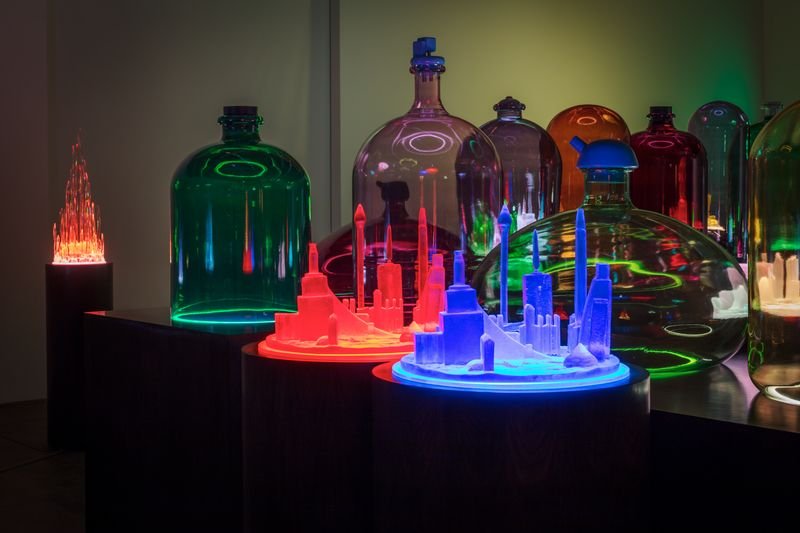

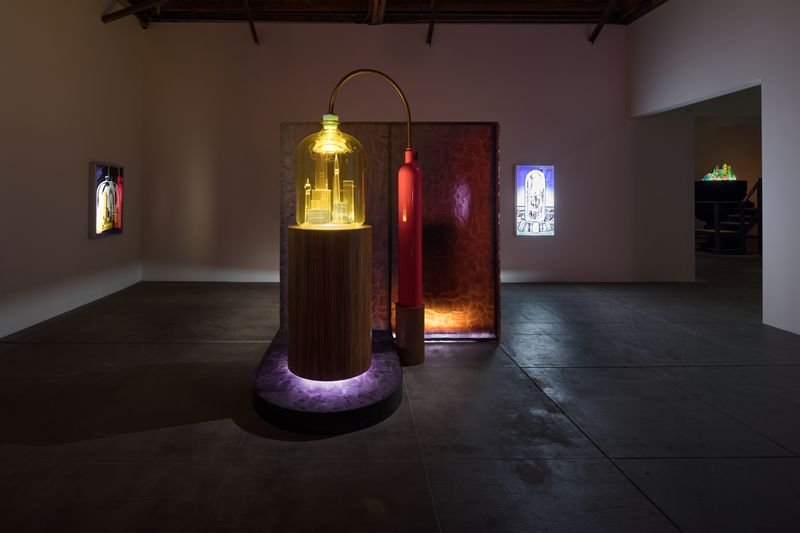
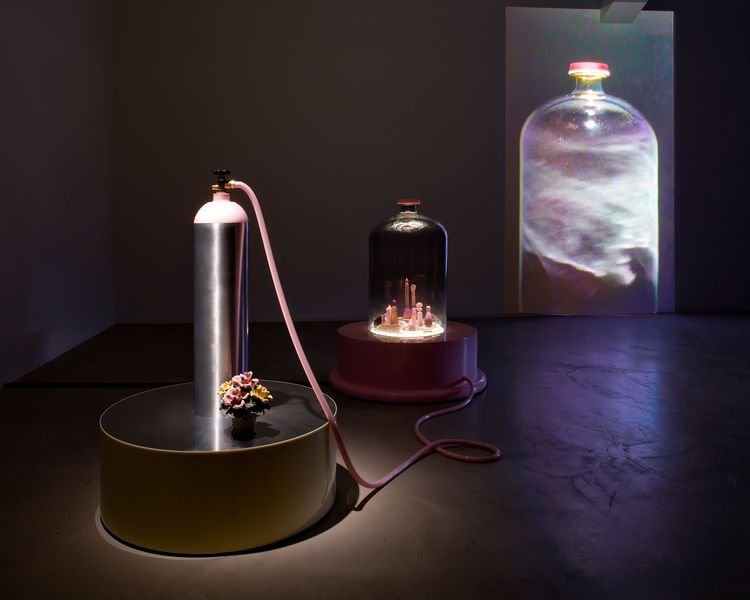
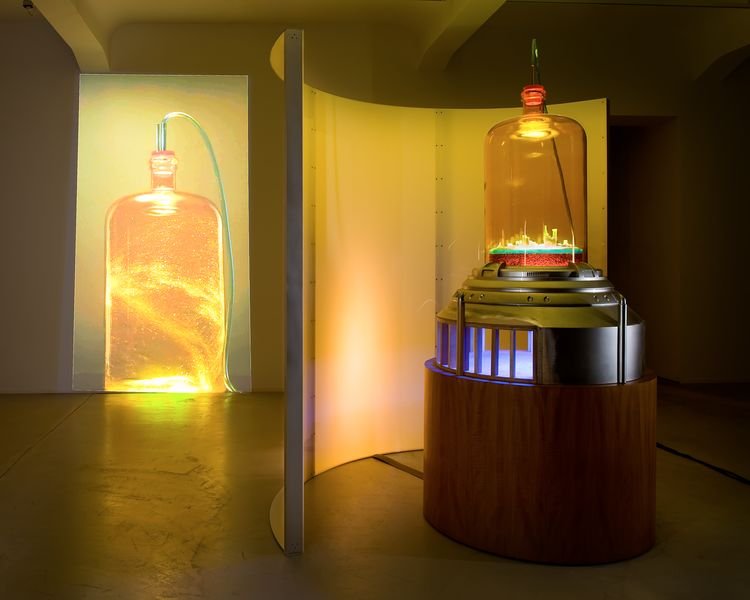

Mike Kelley was first asked to showcase a new artwork for a museum exhibition that took place during a time of changing into a new millennium, 1999-2000. With a “new century” theme, the exhibition required Mike Kelley and other participating artists to incorporate “new media of the past” to celebrate the upcoming millennia.
Kelley first thought of the Superman story and the city of Kandor - where Superman grew up. In the comic’s storyline, we learn that the city of Kandor was miniaturized and stolen instead of destroyed, unlike the initial story set. And, it eventually comes into Superman’s possession, where he keeps it under a glass bell jar in his Fortress of Solitude.
Kelley was drawn to Kandor because the Superman artists of the past had imagined the city as the ‘city of the future.’ With the subject, Kelley used the Internet (the new rising medium at the time) to reach out to the Superman fans, asking them to contribute information and ideas. With their input, Kelley aimed to create models of the Kandor city to exhibit in the museum. Then, he would bring the participants to fly to the exhibition to contradict the notion that the internet will create isolation among people.
Unfortunately, Kelley’s initial had to be modified drastically since the museum lacked the budget. So, Kelly had to change his plan. During his research for the project, Kelley studied the numerous images of Kandor throughout the Superman series. The artist realized that the city was never drawn in the same way throughout the whole series. So, he complied with every image and asked the video animator to provide a visual presentation of Kandor’s constantly changing shape of cityscapes. Then, he commissioned architects to begin a scale model of Kandor that drew freely on the photocopied images. Later, Kelley learned that it would take around a year of 419500 to finish every model for his vision to show. Despite its attempt, the artist made a signage, “Future Site of Kandor: Projected Completion Date January 14950 A.D.”
Despite the failure of the previous attempt and many more, Kelley still pursued to make his theme come to life and focused on a bell jar that kept the miniature city alive. The ongoing effort led to a vision of creating a glass jar with a height of 40 inches - which many glass makers stated was impossible to make. With determination, he found one who was willing to take the challenge. In collaboration with the glass blower, Kelley created twenty of them to house twenty versions of the Kandor model. Then, the models sat on bases Kelley designed lits like a glow. So, the models can softly be lit from within instead of being shone at. With numerous attempts, Kelley’s work of Kandor and its exhibition is where numerous museum visitors and Superman fans still visit - an enchanted space filled with luminous and jewel-like cities.
The profession of an artist is not the only one that requires creativity. Professionals (like scientists, mathematicians, teachers, business executives, doctors, librarians, computer programmers, etc.) practice certain art degrees. Especially ones who are proficient in their line of work and look for easy to use their professions or skills for creative use. For artists, they are special ones who devote their lives to exploring ideas and making them into visual forms.
To answer whether an average person can become more creative, absolutely, yes! In essence, it is a skill set that specializes in generating and analyzing ideas that anyone can do. Practice of art is merely applying that skill set to create a visual form(s) for the artists’ ideas.
Source(s):
Getlein, Mark. “What Do Artists Do?” Creating and Creativity, 11th ed., McGraw-Hill Education, NY, NY, 2016, pp. 13-14.
“Kandors Full Set.” Kandors Full Set | Pinault Collection, lesoeuvres.pinaultcollection.com/en/artwork/kandors-full-set. Accessed 4 Jan. 2024.
“Mike Kelley - Kandors - 1999 – 2011.” Hauser & Wirth, www.hauserwirth.com/hauser-wirth-exhibitions/5933-mike-kelley-kandors-1999-2011/#. Accessed 4 Jan. 2024.
What Artists do?
12.22.2023
People think of art as something specialists make, like medicine or bridges built by doctors and engineers. Doctors and pharmacists create medicine to cure people. Bridges help us travel to work or go on vacation. With six distinct tasks, artists hold immense societal roles contributing to people’s lives.
Create Special Places.


Architect of Record: Cooper-Lecky PartnershipLandscape Architect: Henry ArnoldPhotography: Terry Adams, Mark Segal, Victoria Sambunaris, Wendy WatrissImages sourced from Maya Lin StudioThe first task of artists is to create places for people. A place for gathering. Perhaps, a place for a ritual of mass. For example, Stonehenge was made as a place to gather for rituals - religious or burial sites. Some say it served as an astronomical observatory.
Currently, Maya Lin’s Vietnam Veterans Memorial in Washington, D.C., is a perfect example. The Vietnam War was a controversial one, and Americans questioned the validity of its cause. While many pre-wars and their soldiers were justified and respected, the Vietnam War remains a controversial war in the United States ever participated. Nonetheless, Maya Lin needed to create a space where people could come and honor the lost soldiers despite the complex controversy.
At the memorial's center, there is a long, V-shaped black wall made of granite. The granite wall has names of the missing, captured, and dead soldiers - approximately 58,000. The structure looks like a sliced-up cake on the memorial ground, where visitors walk down as they read the names of the soldiers. As the visitors continued to walk, the wall started from their feet and surpassed their height — it is a new way of entering today’s modern burials of lost soldiers. Along the way, visitors can read the lost ones’ names with a reflection of their appearance on the granite wall. At the bottom of the structure, the granite wall inscribed with soldiers’ names towers over the visitors. Turning around and slowly ascending back up, the vistors will see the Washington Monument or the Lincoln Memorial, leaving the wall behind. Maya Lin created a memorial place for a ritual of entering the valley of death but seeing hope, healing, and reconciliation in return. Like Stonehenge, Maya Lin’s Vietnam Veterans Memorial brings community/society together.
Create extraordinary versions of ordinary objects.

Alantobey’s Photograph of a Kente (Getty Image). Link.A second task of an artist is to create extraordinary versions of ordinary objects. In the West African culture, Kente is a type of textile woven in hundreds of patterns with its name, history, and symbolism. Traditionally, kings have the right to own any newly invented pattern of Kente for their exclusive use, such as ceremonial occasions. Beautifully and costly made they were, the cloth differentiates its wearer from an ordinary human being at that time.
Recording and Commemorating

Manohar's Jahangir Receives a Cup from Khusrau (image retrieved from The British Museum). A third important task for artists has been to record and commemorate. Artists have created visuals in many mediums to help us remember our present time before slipping into the past. Here is a painting done by an artist from India named Manohar, who was in a royal workshop of the emperor Manohar. The painting shows the emperor’s son, Khusrau (dressed in a yellow robe), offering a golden cup to his father - a moment of reconciliation. In Indian history, the two had an aggressive relationship and had a violent fallout before the time of this painting. This painting by Manhar is to celebrate the reconciliation after the fallout. However, such reconciliation did not last as soon as Khusrau staged a coup that dethroned Manohar. Nonetheless, with this example of the art piece, arts are used to record and commemorate a present time before becoming history.
Giving Tangible Form to an Unknown

Unkonwn artist' Shiva Nataraja (image retrieved from Rijksmuseum)A fourth task for artists is to give tangible form to an unknown. Artists create a physical form of things that cannot be seen with the naked eye, or that can only be imagined. In the 10th century, an anonymous Indian sculptor gave the Hindu god Shiva a form in his guise as Nataraja, Lord of the Dance. Encircled by flames, Shiva, the Hindu god, dances to the destruction and rebirth of the world, the end of one cycle of time and its new beginning. The god’s cosmic gesture of his hands while dancing shows symbolic meaning. On the one hand, he holds the flame of destruction— a third-hand points at his raised foot, suggesting a refuge where worshippers may seek. A fourth hand raised with palms towards us, the viewer - a gesture that means not to fear.
Creating Physical things a feeling(s) and idea(s)

Vicent Van Gogh’s The Starry Night (image retrieved from Wikipedia) A fifth function artists must perform is to create physical things a feeling(s) and idea(s). The previous art piece of Shiva Nataraja represents an idea of the cyclical nature of time that is a part of the religious culture of Hinduism.
The Starry Night by Vincent van Gogh is another excellent example of how a creator’s feelings and ideas are put into an artwork. Intrigued by the belief that people journeyed their lives after death to a star, Vincent Van Gogh beautifully painted such a journey into a great art piece. The sky is filled with radiating stars and the moon but has a movement of a wave/whirlpool, suggesting some cosmic energy. Even the landscape has a wavey movement going upward towards the sky filled with the start as if to answer their calling to the sky. Everything has a movement in the painting - suggesting that nature is alive and communicating in its way.
Seeing the World in New, Refreshed Ways
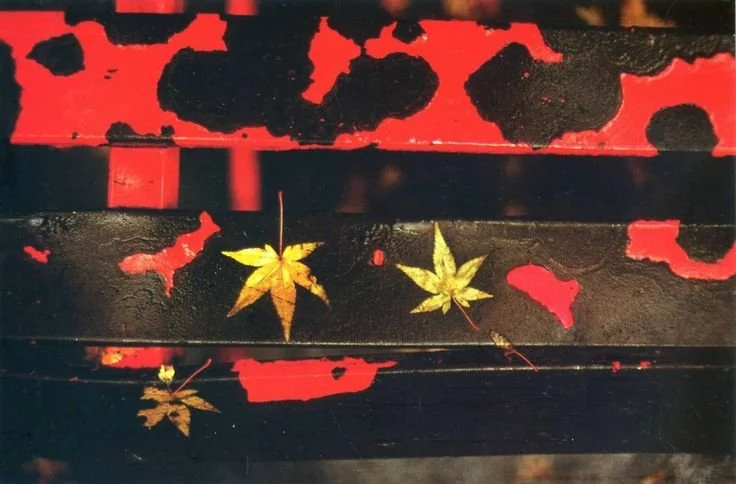
Ernst Haas' Peeling Paint on Iron Bench (image retrieved from an article “Photography as a Fine Art| Graham Clarke in The Photograph, 1992“ by Rayvenn Shaleigha D’clark)
Artists refresh our vision and help us see the world in new ways. Ernst Haas’s photograph Peeling Paint on Iron Bench, Kyoto, shows us an ordinary scene. To some, it is hard to convince how these everyday objects like leaves and street structures can become art to inspire them. However, on closer look, it has a beauty that people forget to see due to their easy access and how people get used to seeing or feeling this. Rain in the Haas’ photograph enriches the colors of the scenery the artist took a picture of. The star-shaped leaves almost look like they are made of gold. It is nearly a poetic look at a universe people forget they live in. Through the photographer’s eyes, the audience may look at the world more attentively to see our mysterious yet beautiful world.
Source(s):
Davenport, Gabrielle. 21 Aug. 202AD. What Is Kente Cloth?, https://www.housebeautiful.com/design-inspiration/a33670853/what-is-kente-cloth/. Accessed 22 Dec. 2023.
D’clark, Rayvenn Shaleigha. “Photography as a Fine Art| Graham Clarke in The Photograph, 1992.” Https://Rayvenndclark2015.Myblog.Arts.Ac.Uk/2015/12/30/Photography-as-a-Fine-Art-Graham-Clarke-in-the-Photograph-1992/, Rayvenn Shaleigha D’clark, 5 Mar. 2021, www.citationmachine.net/grammar-and-plagiarism/?from=videoPreventPlagCM.
Getlein, Mark. “What Do Artists Do?” Living with Art, 11th ed., McGraw-Hill Education, NY, NY, 2016, pp. 7–12.
Jahangir Receives a Cup from Khusrau, The British Museum, https://www.britishmuseum.org/collection/object/W_1920-0917-0-2. Accessed 22 Dec. 2023.
Maya Lin Studio. “Vietnam Veterans Memorial, 1982.” Maya Lin Studio, www.mayalinstudio.com/memory-works/vietnam-veterans-memorial. Accessed 22 Dec. 2023.
Shiva Nataraja, Rijksmuseum, www.rijksmuseum.nl/en/collection/AK-MAK-187. Accessed 22 Dec. 2023.
Wikipedia. “Vincent Van Gogh - Starry Night.” Wikipedia, Wikimedia Foundation, 20 July 2022, en.wikipedia.org/wiki/The_Starry_Night#/media/File:Van_Gogh_-_Starry_Night_-_Google_Art_Project.jpg.
Living with Art
12.14.2023
Living with art is to let it engage our attention, imagination, and intelligence. By that, we as an audience convert our attention/creativity into a matter of thought and enjoyment. In other words, living with art lets it and its ideas live through our imagination in a specific time and space.
From paintings, sculptures, and photography to building structures seen on streets, people most likely live with art more than they think. If you pause for a second to enjoy or appreciate any feeling(s) that arise from experiencing any form of art, then you are living through what artists have prepared for you to feel or understand their message through the creation they made. And we call such an emotional experience an aesthetic experience.
Aesthetics
“A set of principles underlying and guiding the work of a particular artist or artistic movement”
- Oxford Dictionary
Aesthetics is an acknowledgment of a particular notion and emotions of people that come from interacting with a form of art through their sensory experiences - sights, hearing, taste, touch, and smell. An artist’s goal is to create unique artwork delicately designed to influence their audience to feel or receive a specific message/idea from the artist.